
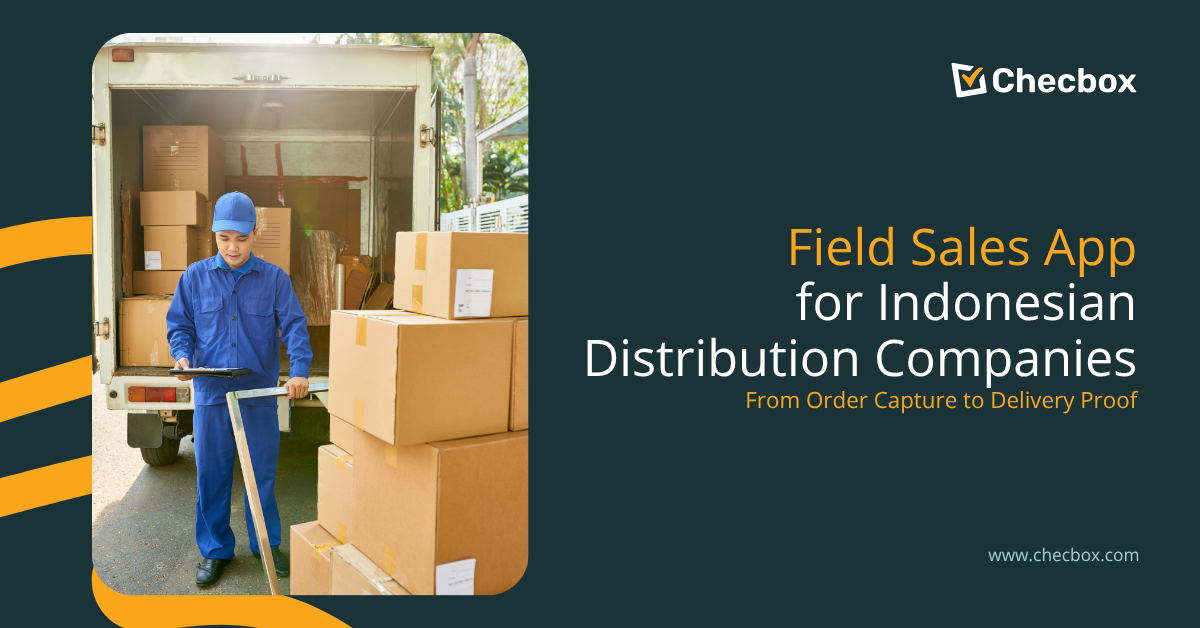
Distribusi produk konsumen di Indonesia menghadapi tantangan yang unik — kepulauan terluas di dunia, infrastruktur yang bervariasi antara Jawa dan wilayah terluar, serta saluran perdagangan tradisional yang masih mendominasi pembelian konsumen sehari-hari.
Indonesia’s consumer distribution challenge is unique in Asia. Eighteen thousand islands, 270 million consumers spread across Java, Bali, Sumatra, Kalimantan, Sulawesi, and beyond, and a traditional trade channel — warungs, tocos, and pasar tradisional — that still accounts for the majority of everyday consumer goods purchases. For FMCG and distribution companies operating in this environment, field force management is not a back-office function. It is the operational core of the business.
The Indonesian distribution complexity
Indonesia’s FMCG distribution structure typically flows from principals (manufacturers or national distributors) through regional distributors to sub-distributors and finally to the salesmen who physically visit warungs, kiosks, and small retailers. This last-mile layer — often called the salesman or SPG (Sales Promotion Girl/Guy) depending on the category — is where brand presence at the neighbourhood level is determined.
The Java-Bali-Sumatra distribution belt handles the majority of organised FMCG distribution volume. Within this belt, major distribution hubs in Jakarta, Surabaya, Bandung, Medan, and Semarang connect to secondary markets through networks of sub-distributors and independent dealers. The further from these hubs, the less reliable the connectivity and the more dependent the distribution system becomes on physical field presence.
Salesman visit tracking with GPS verification
In Checbox, every outlet in a territory — from a premium modern trade account in a Jakarta mall to a warung at a crossroads in Jawa Tengah — is registered in the Places database with GPS coordinates. When the salesman visits an outlet, they check in via the app. The system records GPS coordinates confirming their presence at the correct outlet and the exact timestamp.
For distribution managers in Indonesia, this creates operational visibility that WhatsApp location shares and paper daily call reports cannot provide: which outlets have been visited today, which are on the route but not yet checked in, and which have not received a visit in the past 30 days. Coverage gaps at the outlet level — stores that should be receiving regular service but are not — become visible in real time rather than being discovered weeks later in sales data.
Mobile order capture at traditional trade
Order capture in Indonesian traditional trade typically involves verbal agreement at the outlet, a handwritten nota (order note), and manual re-entry at the distributor depot. Each step introduces the possibility of errors — wrong products, wrong quantities, outdated pricing — and delays between order placement and fulfilment.
In Checbox, the salesman captures the order digitally at the warung during the visit. The product list, pricing, and any active promotional schemes are available on the device — including offline where mobile data is unavailable. Orders are available at the distribution office when the device syncs, without re-entry or manual transcription.
Proof of delivery and cash collection
For distribution operations where drivers deliver product and collect cash or QRIS payments, digital proof of delivery and cash collection tracking addresses two common operational pain points: disputed deliveries (the warung owner claims the product was not received) and cash reconciliation at depot at end of day.
Checbox’s POD module captures recipient signature, delivery photos, and GPS location at the point of delivery. The cash collection module records amounts collected per outlet and provides an automatic day-end reconciliation report — showing total collected, outstanding dues, and any discrepancies requiring investigation.
Offline capability for Indonesian distribution realities
Mobile connectivity in Indonesia is reliable in urban Java and major city centres. It is considerably less reliable in secondary cities, industrial estates outside major hubs, and rural distribution areas. Checbox’s offline-first architecture means that salesmen in areas with intermittent or no mobile data can continue working normally — check-ins, order capture, POD, and cash recording all function without connectivity and sync automatically when coverage returns.
Frequently asked questions
Does Checbox support Bahasa Indonesia for salesmen who do not use English?
Checbox’s form builder allows all form content — field labels, dropdown options, instructions — to be configured in Bahasa Indonesia. System interface localisation for Indonesian market deployment should be discussed with the Checbox team during onboarding.
How does Checbox handle the multi-tier distributor structure common in Indonesian FMCG?
Checbox’s multi-organisation feature supports hierarchical distribution structures. A principal can have visibility across their regional distributors, each regional distributor sees their sub-distributors, and each sub-distributor’s salesmen see their own route and outlet data. Data scoping ensures each level sees what is appropriate to their role.
Can Checbox integrate with the accounting and ERP systems commonly used by Indonesian distributors?
Checbox provides a REST API and webhook support for integration with accounting and ERP systems. Popular Indonesian platforms including ACCURATE and Jurnal.id can be connected through API integration. Contact the Checbox team to discuss specific integration requirements.
Book a free demo for Indonesian distribution companies →
WhatsApp: +61 450 132 620

Content Writer